CRM & automation
Quote follow-up sequences that don’t feel pushy
Most quotes aren’t lost to a competitor. They’re lost to silence. A short, helpful follow-up sequence wins more jobs without annoying anyone.
 LeadsGeeks Team3 min read
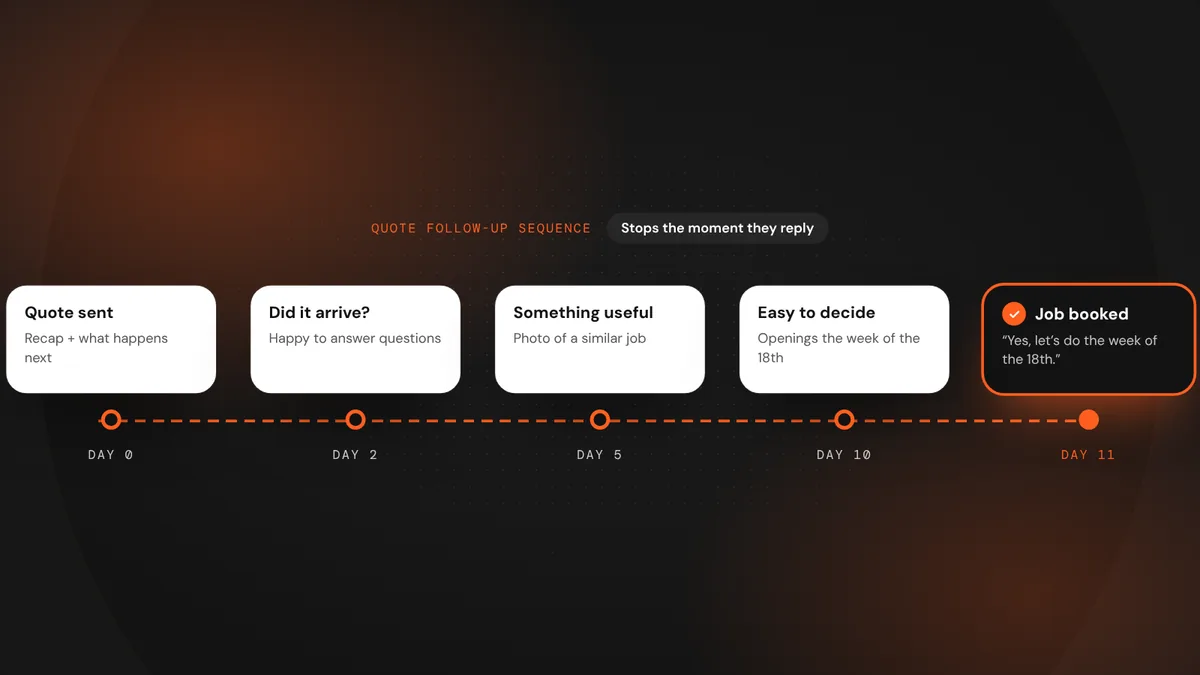
You drove out, measured, wrote a careful quote and sent it. Then nothing. Most homeowners aren’t saying no. They’re busy, comparing, waiting on a spouse or unsure about the price. A few well-timed, genuinely helpful follow-ups bring many of those quotes back to life.
- Most quotes go quiet because people get busy, not because they said no.
- Four to five touches over two to three weeks is enough. Each one should add something useful.
- Automate it in your CRM so it happens on every quote, and stop the moment they reply.
Why quotes go quiet
- They’re collecting other quotes and haven’t compared yet.
- They need to talk to a partner or check their budget.
- They have questions but don’t want to feel sold to.
- Life got busy and the quote got buried in their inbox.
None of those are a “no.” A follow-up that helps with any of them, by answering questions, offering options or simply reminding them, gives them an easy way back to you.
A sequence that works
- Same day: send the quote with a personal note.Recap what you discussed, what’s included and what happens next.
- Day 2: check it arrived and offer to answer questions.Short and friendly. Many people reply here with a simple question.
- Day 5: add something useful.A photo of a similar job, a review from a nearby customer or a financing option.
- Day 10: make it easy to decide.Mention your schedule (“we have openings the week of the 18th”) or offer a smaller option.
- Day 21: a respectful close.Ask if they’d like you to keep the quote open. This often gets the most honest replies.
Templates you can adapt
Hi {first name}, it’s {name} from {business}. Just making sure the quote for your {project} came through okay. Happy to answer any questions, whether here by text or on a quick call.
Hi {first name}, thought you might like to see a {project} we finished last month in {nearby town}: {photo/link}. If it helps, we also offer financing with low monthly payments. Just let me know.
Hi {first name}, our schedule for {month} is filling up, and we still have a couple of openings the week of {date}. Would you like me to hold one for your {project}?
Hi {first name}, I don’t want to keep filling up your phone. Should I keep your quote open, or have you gone another direction? Either way, thanks for considering {business}.
Keep the tone right
- Use their name and mention their specific project every time.
- Every message should help: an answer, a photo, an option, a date. Never “just checking in.”
- Keep texts under three sentences. Save longer details for email.
- No fake deadlines or “price expires tonight” pressure.
Automate it
Set the sequence up in your CRM so it starts automatically when a quote is sent, and stops the moment the customer replies, books or declines. Mix text and email, and let a person take over as soon as there’s a reply. Automation makes sure every quote gets followed up, including the ones that would otherwise fall through the cracks.
Frequently asked questions
How many follow-ups is too many?
Four or five touches over two to three weeks is a good limit. Stop immediately if they reply, book or say no.
Should I follow up by text or email?
Both. Texts get read faster for short check-ins, while email works better for details like photos, options and financing information.
What if they say they went with someone else?
Thank them, ask if they’re willing to share why (price, timing or something else), and stay in touch. Some come back when the other company falls through.
LeadsGeeks TeamWe build search, review and follow-up systems for local service businesses: the pages, profiles and automations that turn searches into booked jobs. CRM & automationMissed calls are lost jobs: setting up text-back
 CRM & automationSpeed to lead: answer new leads in minutes, not hours
 AI searchWhat AI search readiness means for a local service business