AI search
How AI assistants decide which local businesses to recommend
When ChatGPT, Gemini or Google’s AI Overviews name a local business, they’re summarizing what the web says about it. Here’s where that information comes from, and how to shape it.
 LeadsGeeks Team3 min read
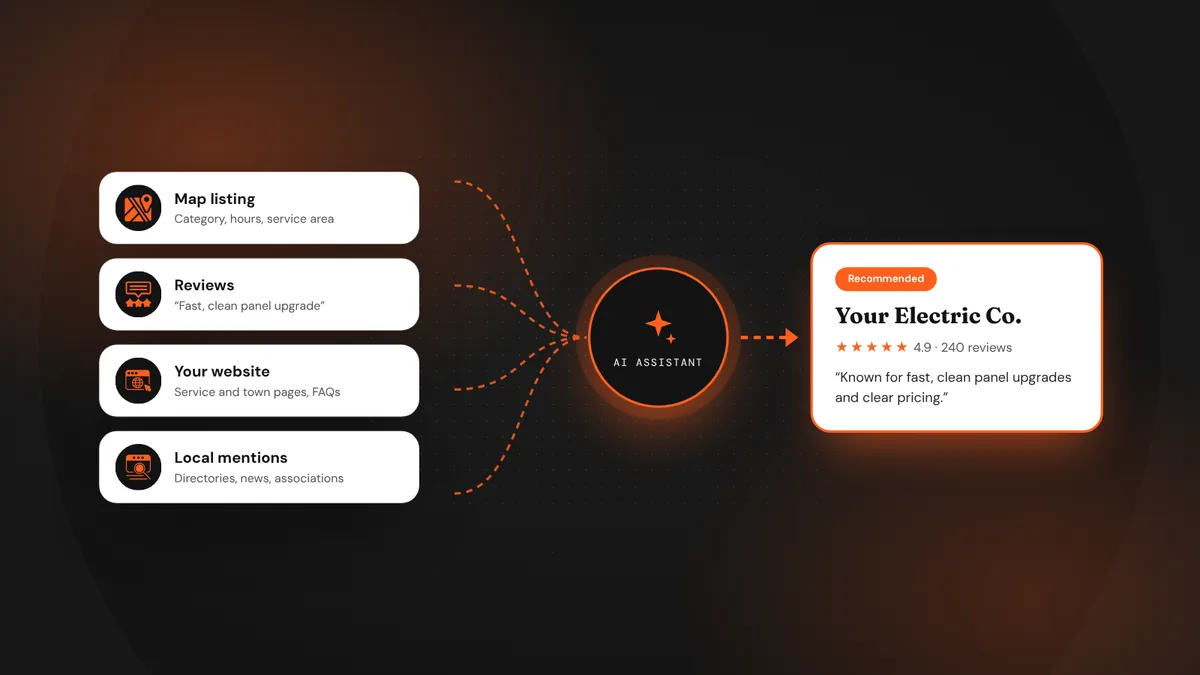
Ask an AI assistant “Who’s a good electrician near me?” and you’ll get a few names, often with a reason for each: great reviews, fast response, specializes in panel upgrades. Those reasons aren’t invented. They’re pulled from what the web already says about each business. Understanding where that comes from is the first step to being on the list.
- Assistants combine search results, map data, reviews and your own website to pick recommendations.
- They favor businesses whose details are consistent and whose strengths are stated clearly in many places.
- You influence them the same way you influence customers: clear information, real proof and a good reputation.
Where assistants get their information
Different assistants work differently, and they change often, but most draw on a similar mix of sources when answering a local question:
How they choose who to name
An assistant is trying to give a safe, useful answer. That pushes it toward businesses that are:
- Clearly relevant.The business obviously offers the exact service asked about, in the area asked about, and says so on its own pages.
- Consistently described.The name, location, services and hours match across sources. Conflicting information makes a recommendation risky.
- Well reviewed, recently.Strong ratings, a healthy number of reviews, and recent ones. Review text that mentions specific strengths gives the assistant reasons to quote.
- Easy to explain.Businesses with a clear specialty or standout trait, like 24/7 service, a family business since 1998 or certified Tesla charger installers, are easier to recommend with a reason.
How to shape what they say about you
- State your strengths plainly on your site. If you offer same-day service, a lifetime warranty or financing, say so in simple sentences on the relevant pages.
- Encourage detailed reviews. Ask customers to mention the service and what stood out. Never script or incentivize reviews.
- Fix inconsistencies. Old addresses, former business names and outdated phone numbers confuse every system that reads them.
- Get mentioned locally. Sponsorships, local news, chambers of commerce and trade associations add independent proof.
- Answer real questions. FAQ content that matches how people ask questions out loud is easy for assistants to use.
Check what assistants say today
Ask two or three assistants the questions your customers ask: “best [service] in [town],” “who does [specific job] near me,” “is [your business] any good?” Write down whether you’re named, what’s said about you, and any errors. Repeat monthly. It’s the simplest way to see whether your work is changing the answer.
AI assistants are a new front door, but what’s behind it is familiar: be clear about what you do, be consistent everywhere, and earn a reputation worth repeating.
Frequently asked questions
Do AI assistants use Google reviews?
Some do, through Google’s own AI features. Others pull from different sources like Bing, Yelp or the wider web. That’s why reviews on several platforms help.
Why does the assistant say something wrong about my business?
Usually because outdated or conflicting information exists somewhere online, like an old address or a closed location. Fixing it at the source is the best correction.
Is structured data (schema) required?
It isn’t required, but it helps systems read your services, hours and service area accurately. It’s a small, one-time setup.
LeadsGeeks TeamWe build search, review and follow-up systems for local service businesses: the pages, profiles and automations that turn searches into booked jobs. AI searchWhat AI search readiness means for a local service business
 AI searchHow to write FAQ answers AI assistants can quote
 Local SEOHow to win the Google map pack in your service area